

Characterizing quantum defects in hexagonal boron nitride
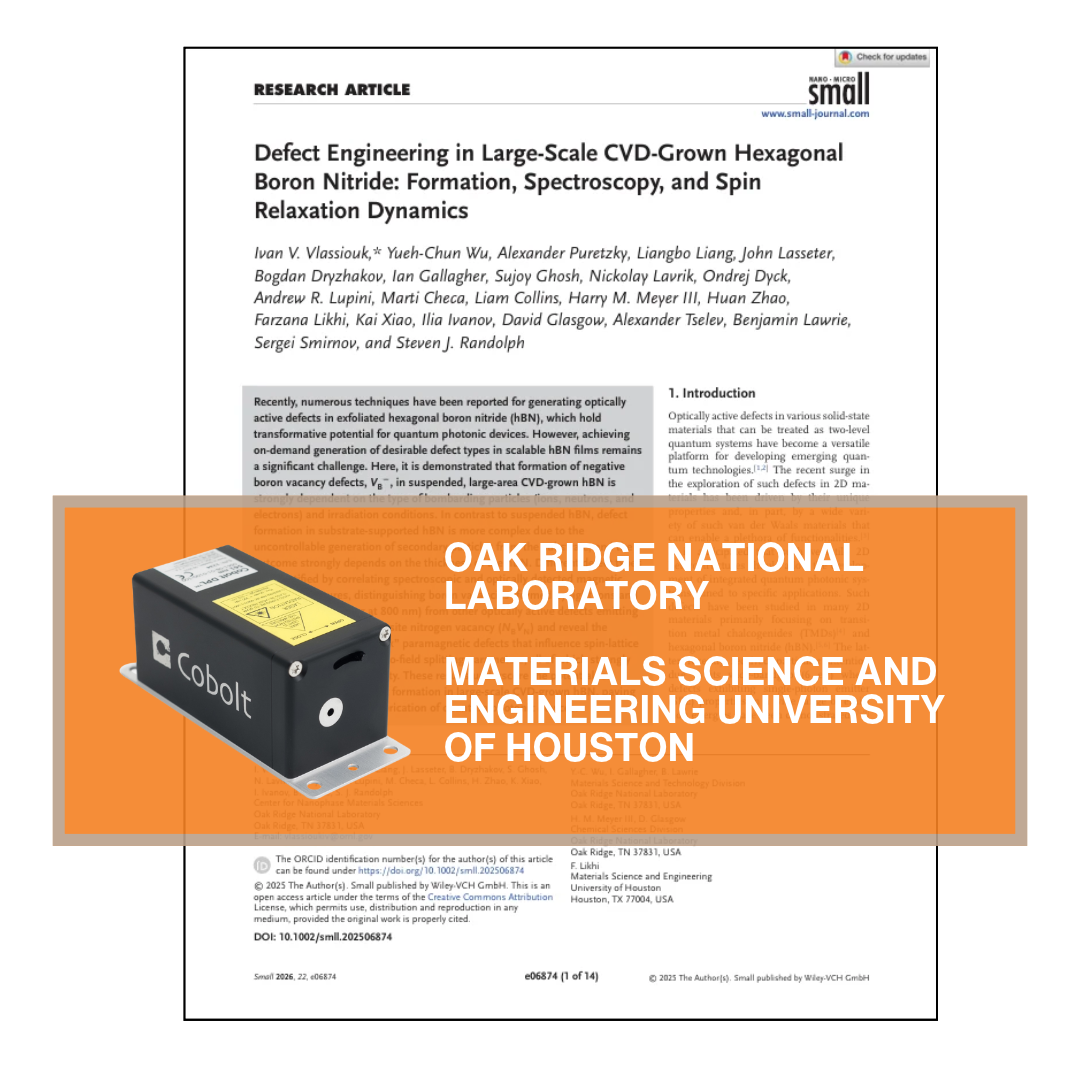
Defect Engineering in Large-Scale CVD-Grown Hexagonal Boron Nitride: Formation, Spectroscopy, and Spin Relaxation Dynamics
Researchers at Oak Ridge National Laboratory and the Materials Science and Engineering University of Houston have demonstrated a scalable approach for creating and characterizing quantum defects in large-area hexagonal boron nitride (hBN), bringing practical quantum photonic devices one step closer to reality.
Their work, which was published in the latest issue of Small, shows how specific atomic defects can be deliberately engineered in hBN using controlled irradiation techniques and confirms their quantum properties optical measurements enabled by the Cobolt 06-01 laser. A key role of the laser was to provide the optical excitation required to probe the quantum states associated with the engineered defects.
Hexagonal boron nitride (hBN), also known as “white graphene”, is a synthetic layered 2D material made of alternating boron and nitrogen atoms arranged in a hexagonal crystal lattice.
When specific defects are introduced into its crystal lattice, the material can host quantum states that emit light and respond to magnetic fields, making it attractive for applications such as quantum sensing, quantum communication, and single-photon sources.
To verify the quantum nature of the engineered defects, the team performed optically detected magnetic resonance (ODMR) measurements. In this technique, the defects are illuminated while microwave fields are applied, allowing researchers to probe their quantum spin states through changes in emitted light.
The Cobolt laser was used to optically excite the defect ensemble during these ODMR experiments. The photoluminescence emitted from the hBN defects was then monitored, allowing the researchers to identify and distinguish different defect types, including boron-vacancy centers with characteristic spin properties.
These measurements were essential for correlating the optical and magnetic signatures of the defects and evaluating their potential for future quantum technologies.
 Go back to all publications
More resources
Looking for more in-depth information? Visit our Knowledge Bank page for detailed articles and insights on our products and technologies.