

Optical Aharonov-Bohm effect in twisted bilayer MoS2
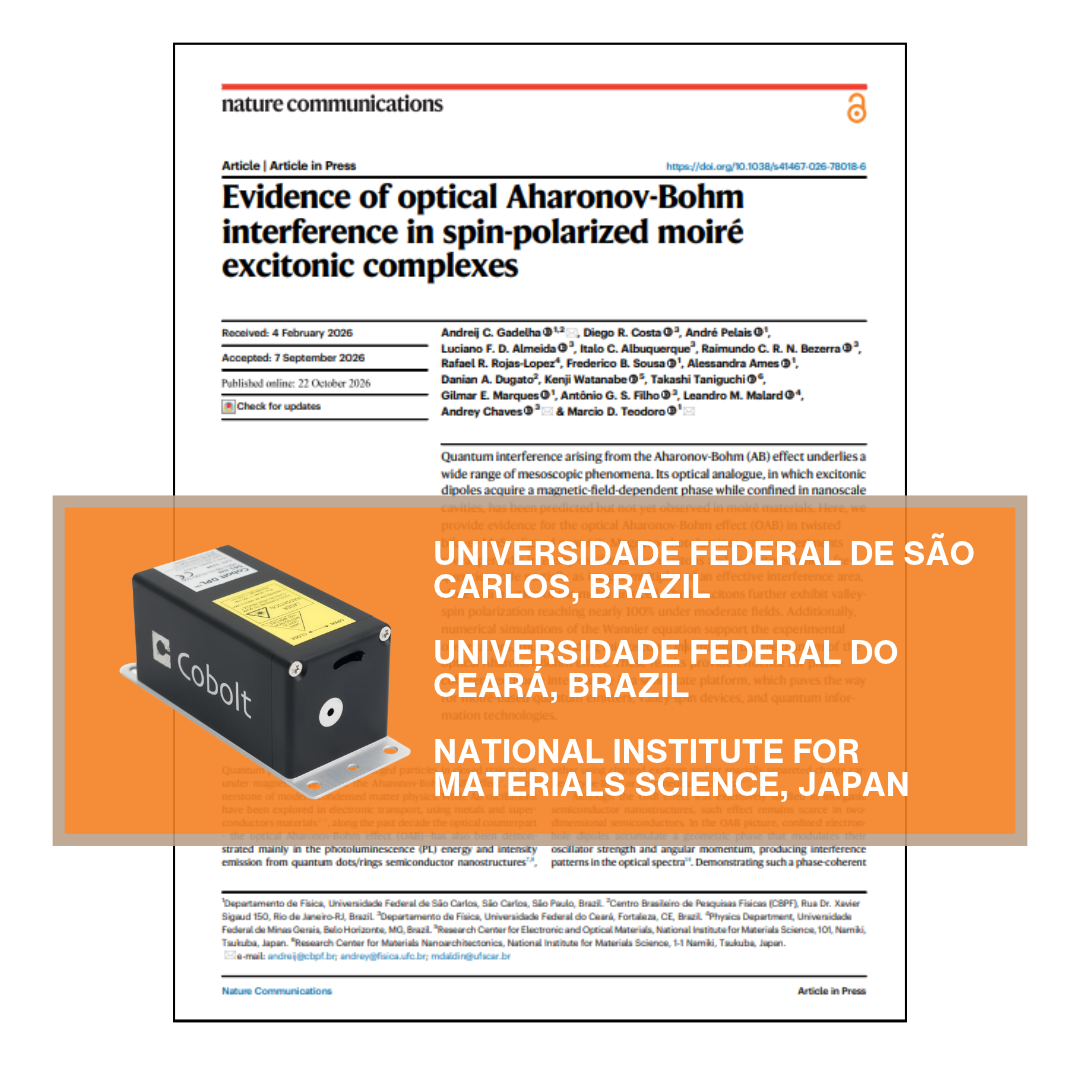
Evidence of optical Aharonov-Bohm interference in spin-polarized moiré excitonic complexes
Researchers from Universidade Federal de São Carlos, Universidade Federal do Ceará, and collaborators have reported evidence of the long-sought optical Aharonov-Bohm effect in twisted bilayer MoS₂, a two-dimensional semiconductor with a nanoscale moiré structure.
Published in Nature Communications, the work demonstrates how magnetic fields can control the quantum interference of excitonic states, highlighting the potential of moiré materials as a platform for future quantum photonic and quantum information technologies.
To probe these quantum phenomena, the researchers performed low-temperature magneto-photoluminescence measurements using the 532 nm Cobolt 08 Series laser as the excitation source. The laser provided stable, high-quality optical excitation required to generate and study excitons and biexcitons within the material.
By combining the laser excitation with high-resolution spectroscopy under varying magnetic fields, the researchers were able to detect the subtle oscillations in light emission that serve as evidence of optical Aharonov-Bohm interference.
The results show that moiré-engineered two-dimensional semiconductors can be used to manipulate quantum states of light and matter, opening new opportunities for developing advanced quantum optoelectronic devices.
 Go back to all publications
More resources
Looking for more in-depth information? Visit our Knowledge Bank page for detailed articles and insights on our products and technologies.