

Tunable light speeds up the search for the perfect qubit
Physicists are still looking for the perfect quantum qubit: a two-level quantum system that can be precisely measured and controlled, while remaining unaffected by its environment. One of the most promising candidates are defect centres in solid-state materials, also known as colour centres, which have been found to emit a single photon per excitation event when excited by laser light of a particular frequency.t.
Most early attention has focused on nitrogen vacancy centres in diamond − which offer single-photon emission at room temperature − but they are not ideal for all applications because their asymmetric charge distribution makes them sensitive to local fluctuations in the electric field.
Researchers are therefore investigating the properties of different colour centres in diamond, including silicon and germanium vacancies, as well as other material systems such as 2D hexagonal boron nitride (hBN). But it can be difficult and time consuming to map out the energy levels
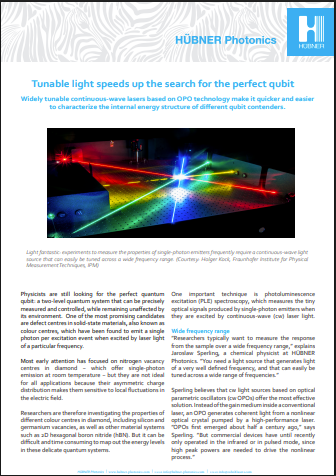
in these delicate quantum systems. One important technique is photoluminescence excitation (PLE) spectroscopy, which measures the tiny optical signals produced by single-photon emitters when they are excited by continuous-wave (cw) laser light.
 Go back to all publications
More resources
Looking for more in-depth information? Visit our Knowledge Bank page for detailed articles and insights on our products and technologies.