

C-WAVE VIS and C-WAVE GTR in Coherence Imaging Spectroscopy
Researchers at the Max Planck Institute for Plasma Physics (Germany), Auburn University (USA), the University of Seville (Spain), as well as the W7-X Team, in collaboration with HÜBNER Photonics have presented new findings in fusion experiments. The study, published in Review of Scientific Instruments, validates new methods for estimating “delay dispersion” in Coherence Imaging Spectroscopy (CIS), a key parameter required to translate raw optical signals into meaningful plasma data.
Coherence Imaging Spectroscopy (CIS) is a camera-based polarization interferometry technique that allows scientists to measure ion flow velocities and temperatures in fusion plasmas with high spatial resolution. Over the past decade, CIS has matured significantly and is now deployed across multiple fusion devices, including the Wendelstein 7‑X (W7‑X) stellarator.
However, given the high wavelength sensitivity typical of the CIS systems one persistent challenge has been the ability to achieve a reliable calibration procedure close to the target spectral line.
Moreover, CIS relies on birefringent crystals that naturally introduce wavelength‑dependent phase variations (a phenomenon known as group delay dispersion). If not accurately characterized, this dispersion can distort the inferred plasma parameters.
To address these challenges the researchers introduce two new estimation approaches validated using the C-WAVE VIS and C-WAVE GTR continuous‑wave tunable lasers. These lasers span the 450–750 nm range without gaps, enabling comprehensive testing.
The results show that the simplest CIS configuration produced the most accurate predictions, with estimated dispersion deviating less than 2% from measured values. While the more complex CIS setups showed deviations up to 20%, especially in cases where optical imperfections caused spatial patterns that the tested estimation methods could not fully capture.
 Go back to all publications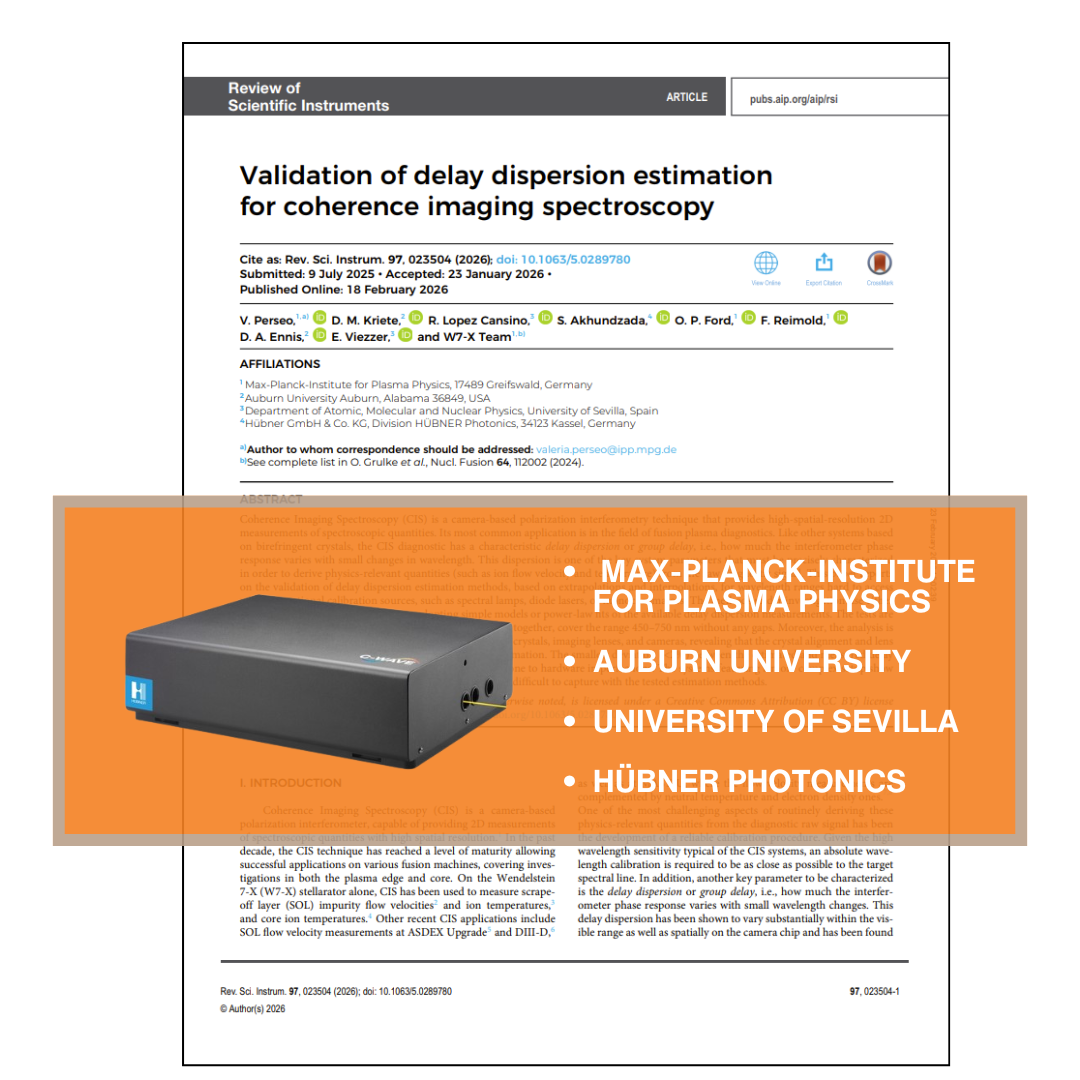
More resources
Looking for more in-depth information? Visit our Knowledge Bank page for detailed articles and insights on our products and technologies.