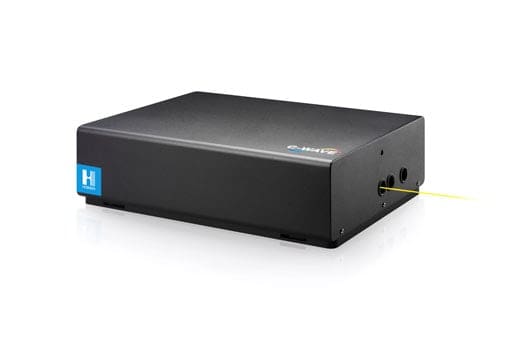
C-WAVE Series

Widely tunable single frequency CW lasers

C-WAVE tunable lasers are widely tunable continuous wave (cw) laser light sources covering an unprecedented range of wavelengths in the visible and near IR range.

  • Wavelength coverage from 450 nm up to 3.5 µm
  • Up to 250 nm gap-free tuning range in the visible 
  • Single frequency operation with < 500 kHz typical linewidth
  • Output powers up to Watt-level

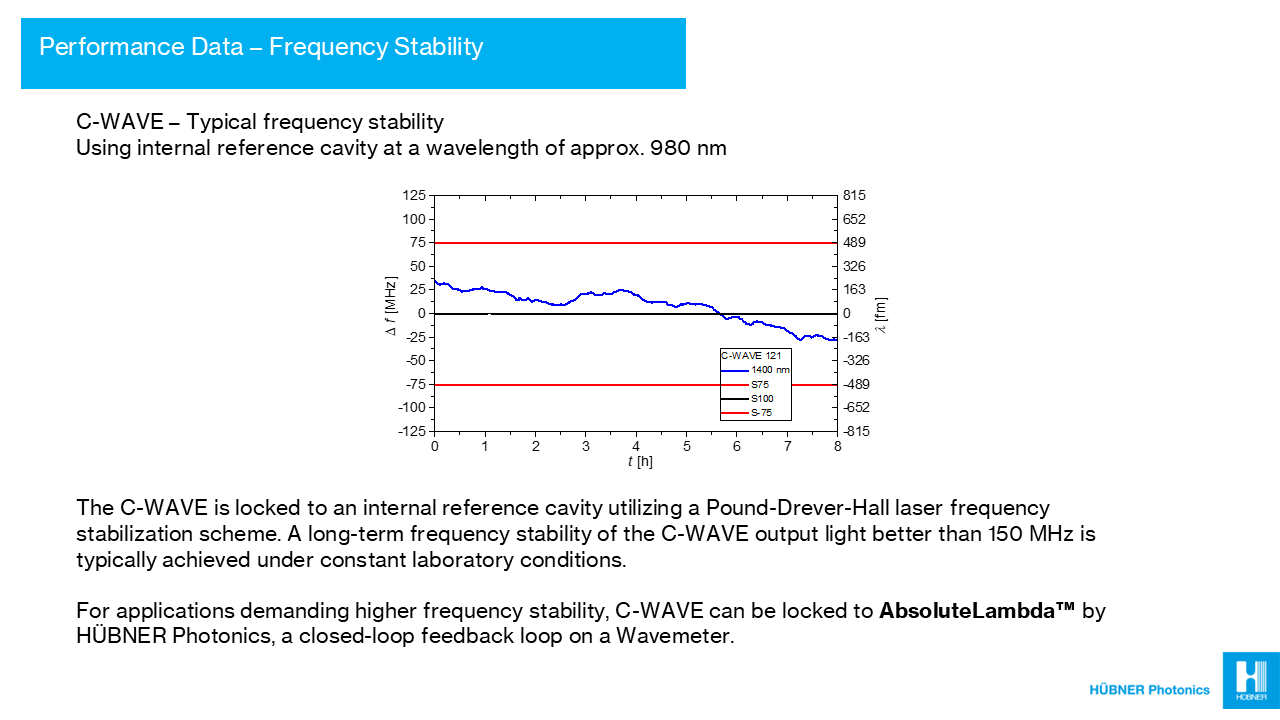
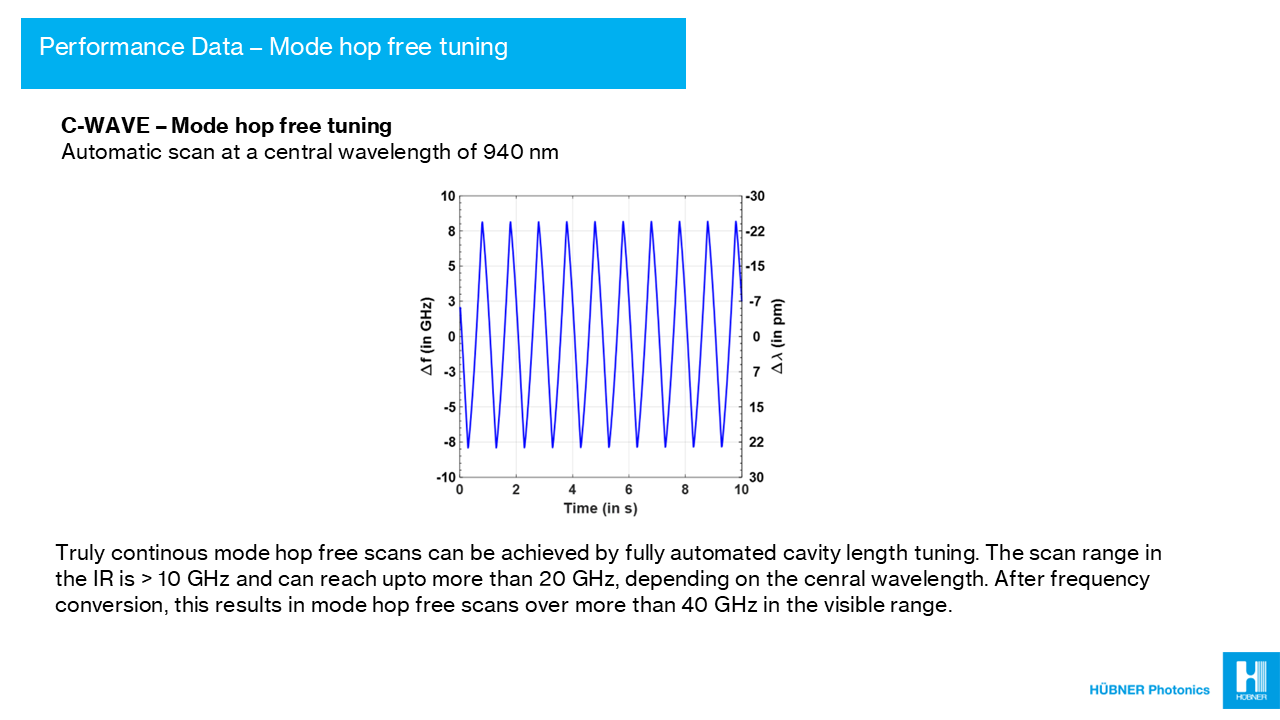
C-WAVE tunable lasers offer several tuning mechanisms, ranging from a fully automated wavelength approach to truly continuous mode-hope free scans over tens of GHz. In closed-loop operation, a long term frequency stability as good as +/- 2 MHz over hours can be achieved. They operate fully automated without the requirement of consumables.

Model Overview

The C-WAVE product line makes use of optical parametric oscillators and Ti:Sapphire lasers to cover the visible and NIR wavelength range. Different pump laser power and wavelength option tailor C-WAVE to your application in Holography, High resolution spectroscopy or Resonant Raman spectroscopy.
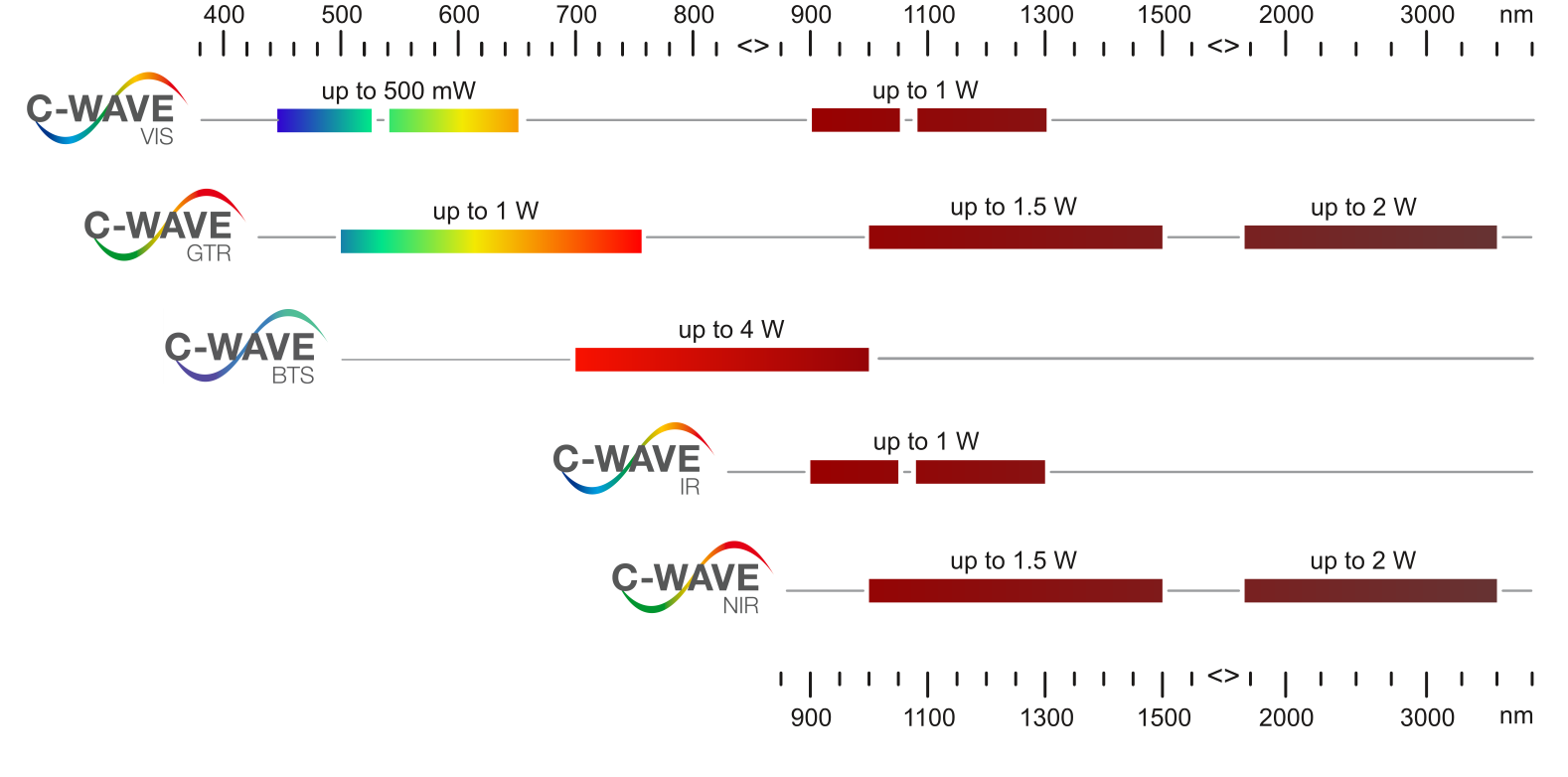
 

Spectral coverage of C-WAVE

Applications

C-WAVE tunable lasers are field proven in applications such as color center research and other Quantum technologies, Nanophotonics, holography, Raman spectroscopy, fluorescence microscopy, and high resolution spectroscopy.

Specifications

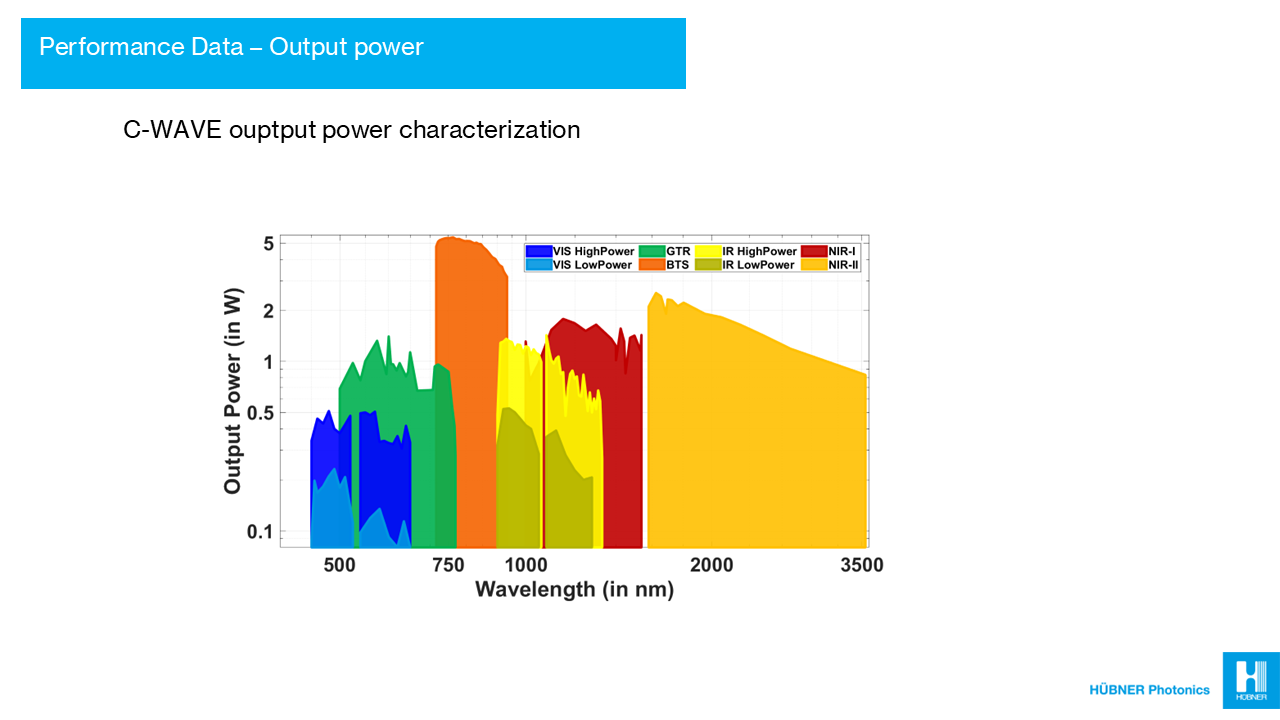
C-WAVE model Tuning Range Output Power
C-WAVE VIS Low Power 450 - 525 nm and
540 - 650 nm and
900 - 1050 nm and
1080 - 1300 nm
up to 200 mW
up to 200 mW
up to 400 mW
up to 400 mW
C-WAVE VIS High Power 450 - 525 nm and
540 - 650 nm and
900 - 1050 nm and
1080 - 1300 nm
up to 500 mW
up to 500 mW
up to 1 W
up to 1 W
C-WAVE GTR 500 - 750 nm and
1000 - 1500 nm and
1700 - 3500 nm
up to 1 W
up to 1.5 W
up to 2 W
C-WAVE BTS 700 - 1000 nm >750 mW, up to 5W @ peak wavelength
C-WAVE IR Low Power 900 - 1050 nm and
1080 - 1300 nm
up to 400 mW
up to 400 mW
C-WAVE IR High Power 900 - 1050 nm and
1080 - 1300 nm
up to 1 W
up to 1 W
C-WAVE NIR 1000 - 1500 nm and
1700 - 3500 nm
up to 1.5 W
up to 2 W

For detailed specification table, see data sheet.

Performance Data (click to enlarge)

Data sheets

 C-WAVE Widely Tunable Lasers Datasheet

Manuals

Please contact us on info.de@hubner-photonics.com for a copy of the manual.

Literature

Publication Application Reference

Anomalous Intensity Quenching of Resonant Raman Scattering in Atomically Thin MoS2

Mei et.al.

Raman Spectroscopy Laser and Photonics Review 2025

Double Tips for In-Plane Polarized Near-Field Microscopy and Spectroscopy
Kusch et.al.

Raman Spectroscopy Nano Letters 2024

Narrow Linewidth Lasers for Brillouin Light Scattering Spectroscopy
Peters et.al.

Brillouin scattering Application Note
Interlayer bond polarizability model for interlayer phonons in van der Waals heterostructures
R. Mei et.al.
Raman Scattering Nanoscale 2024
Chirality Dependence of Triplet Excitons in (6,5) and (7,5) Single-Wall Carbon Nanotubes Revealed by Optically Detected Magnetic Resonance
I. Sudakov et.al.
Raman Spectroscopy ACS Nano Feb. 2023
Wavelength Dependence of the Electrical and Optical Readout of NV Centers in Diamond
L Todenhagen et. al.
Quantum aiXiv. Jul
2023
Continuous-wave frequency upconversion with a molecular optomechanical nanocavity
W Chen et. al.
Spectroscopy Science. Dec
2022
Mastering challenges in holography with widely tunable CW optical parametric oscillators
Stefan Trotzky et. al.
OPO Technology Proc. SPIE 12026
2022
Laser light tunable across the visible up to mid-infrared: Novel turnkey cw OPO with efficiency-optimized design
J. Sperling et. al.
OPO Technology AIP Rev. Sci. Inst 2021
Giant Rydberg excitons in Cu2O probed by photoluminescence excitation spectroscopy
M. A. M. Versteegh et. al.
Rydberg Excitons arXiv 2021
Strong light-matter coupling in MoS2
P. Kusch et. al.
SNOM Phys.Rev. B 2021
High-Power CW Optical Parametric Oscillator Design for gap-free Wavelength Tuning across the Visible
K. Hens et. al.
OPO Technology CLEO 2021
Advances in the spectral coverage of tunable continuous-wave optical parametric oscillators
J. Sperling et. al.
OPO Technology Proc. SPIE 2021
Coherence imaging spectroscopy at Wendelstein 7-X for impurity flow measurements
V. Perseo et. al.
High Resolution Spectroscopy Rev. Sci. Inst. 2020
Tunable light speeds up the search for the perfect qubit
K. Hens et al.
Quantum Physics World 2020
Colors expanded: Widely tunable lasers are tailored for quantum research
K. Hens and J. Sperling
OPO Technology Laser Focus World 2020
Widely tunable CW optical parametric oscillators: mastering the challenges posed in quantum technology
K. Hens et. al.
Quantum Proc. SPIE 2020
Photoelectrical imaging and coherent spin-state readout of single nitrogen-vacancy centers in diamond
F. Jelezko and co-workers
Color Centers Science 2019
Phonon-assisted emission and absorption of individual color centers in hexagonal boron nitride
R. Bratschitsch and co-workers
Quantum 2D Materials 2019
Optical Gating of Resonance Fluorescence from a Single Germanium Vacancy Color Center in Diamond
W. Gao and co-workers
Color Centers Phys. Rev. Lett. 2019
A new calibration implementation for Doppler Coherence Imaging Spectroscopy
D. Gradic et. al.
High Resolution Spectroscopy Fusion Eng. and Design 2019
Lasers for holographic applications: important performance parameters and relevant laser technologies
K. Hens et. al.
Holography Proc. SPIE 2019
Optical Parametric Oscillators: Novel tunable lasers enable new nanoimaging techniques
J. Sperling et. al.
Raman Laser Focus World 2019
Excitation-Tunable Tip-Enhanced Raman Spectroscopy
P. Kusch and co-workers
Raman J. Phys. Chem. C. 2018
Narrow linewidth measurement with a Fabry-Perot interferometer using a length modulation technique
F. A. Franz
OPO Technology Master Thesis University of Kassel 2018
Made Easy: CW Laser Light Widely Tunable Across the Visible
J. Sperling and K. Hens
OPO Technology Optik & Photonik 2018
Tunable Laser Light Sources Advance Nanophotonics Research
J. Sperling and K. Hens
Nanophotonics EuroPhotonics 2018
Photoluminescence excitation spectroscopy of SiV− and GeV− color center in diamond
A. Kubanek and co-workers
Color Centers New Journal of Physics 2017

Software

Please contact us on info.de@hubner-photonics.com for the latest software version.

Drawings

Please contact us on info.de@hubner-photonics.com for drawings.

Browse through our dedicated playlists

lasers for holography


Options & Accessories

     
Absolute lambda    
Absolute Lambda for frequency stabilization


See more options and accessories

FAQs

Am I required to choose between wavelength ranges for my C-WAVE tunable laser?2025-12-03T15:57:48+01:00

Each model of C-WAVE tunable laser is equipped with all optics required to cover the whole range available for the model. All tuning and optics adjustment is done automatically.

The available ranges between the different models are dictated by the choice of technology and pump laser wavelength. Each model of C-WAVE tunable laser is equipped with all optics required to cover all ranges listed for the model.

What is the technology behind C-WAVE tunable lasers?2025-12-03T16:04:23+01:00

We employ several technologies to offer a variety of wavelength tuning ranges.

Continuous wave optical parametric oscillators (cw OPO) rely on a process referred to as parametric down-conversion in a nonlinear optical crystal, rather than on stimulated emission in a laser gain medium. As such, tunable cw OPOs unlock wavelength ranges that cannot be reached with other tunable laser technologies. Tailored to the desired output range, they can cover a broad spectrum in the infrared.

Titanium Sapphire lasers can cover the wavelength range of 700 to 1000 nm with very high output powers and rapid tunability.

Both technologies can be combined with Second Harmonic Generation (SHG) to cover the visible and UV region of the optical spectrum.

The main difference between our C-WAVE VIS models (operating at 900 to 1300 nm and 450 to 650 nm) and our C-WAVE GTR (500 to 750 nm as well as 1000 to 1500 nm and 1700 to 3400 nm) is the pump laser wavelength.

What is the output power versus wavelength of a C-WAVE tunable laser?2025-12-03T16:09:09+01:00

We distinguish between minimum output power and output power at maximum gain.

The minimum output power is a conservative output power specification valid over the entire tuning range. The output power at maximum gain refers to the minimum achievable power at the peak of the output power vs. wavelength curve.

Note that the achievable minimum output power and output power at maximum gain differ by more than a factor of two.

For further information on output power versus wavelength of C-WAVE tunable lasers, please refer to the typical power tuning curves shown in the “Performance Data” tabs – or contact us at info.de@hubner-photonics.com to discuss potential custom-tailored power optimization.

Can C-WAVE tunable lasers emit at multiple wavelengths simultaneously?2025-12-03T16:11:32+01:00

Yes. When a C-WAVE tunable laser emits a particular wavelength in the visible range, laser light at twice that wavelength is emitted from the infrared output port simultaneously.

For example, when C-WAVE is operated at 600 nm in the visible range, then laser light at 1200 nm is available in the infrared port.

C-WAVE GTR can in addition to the visible range SHG channel emit Signal (1000 to 1500 nm) and Idler (1700 to 3400 nm) at the same time.

Note that arbitrary wavelength combinations are not possible. Beside the tunable outputs from the visible and the infrared port, C-WAVE also offers access to the undepleted (remaining) pump laser beam from a third, separate output port.

Why are there gaps in the wavelength tuning range of C-WAVE VIS and C-WAVE IR2025-12-03T16:14:26+01:00

C-WAVE IR and C-WAVE VIS are based on a sequence of nonlinear optical processes in two cavities, that we usually refer to as OPO and SHG cavity, respectively.

Pump laser photons (532 nm) are first split in the OPO cavity into pairs of photons of lower energy, referred to as signal photons (with wavelengths below 1064 nm) and idler photons (with wavelengths longer than 1064 nm).

The OPO cavity operates on resonance at either a particular signal wavelength, or a particular idler wavelength, while its counterpart is extracted for use or frequency conversion. As a consequence, when tuning across 1064 nm, the cavity mirrors are switched from highly-reflective to highly-transmissive.

While this switch of optics hardware is fully automatized, the transmission/reflectivity edges of the mirror coatings are not infinitely steep. Therefore, the range 1050-1080 nm usually is not practicable for highly-stable, single-resonant cavity operation. Consequently, specifications cannot be guaranteed in the 1050-1080 nm range, respectively the frequency-doubled analogue 525-540 nm.

Please contact us info.de@hubner-photonics.com  for any inquiries on custom-tailored wavelength coverage.

How long does an automatic wavelength approach for C-WAVE tunable lasers take?2025-12-03T16:16:33+01:00

The fully automatic wavelength approach of a C-WAVE laser takes between 30 seconds and less than ten minutes.

This approach is optimizing the output power at the desired wavelength by several analytical scans of actuators inside the system, to provide optimum laser light output without further user-interaction.

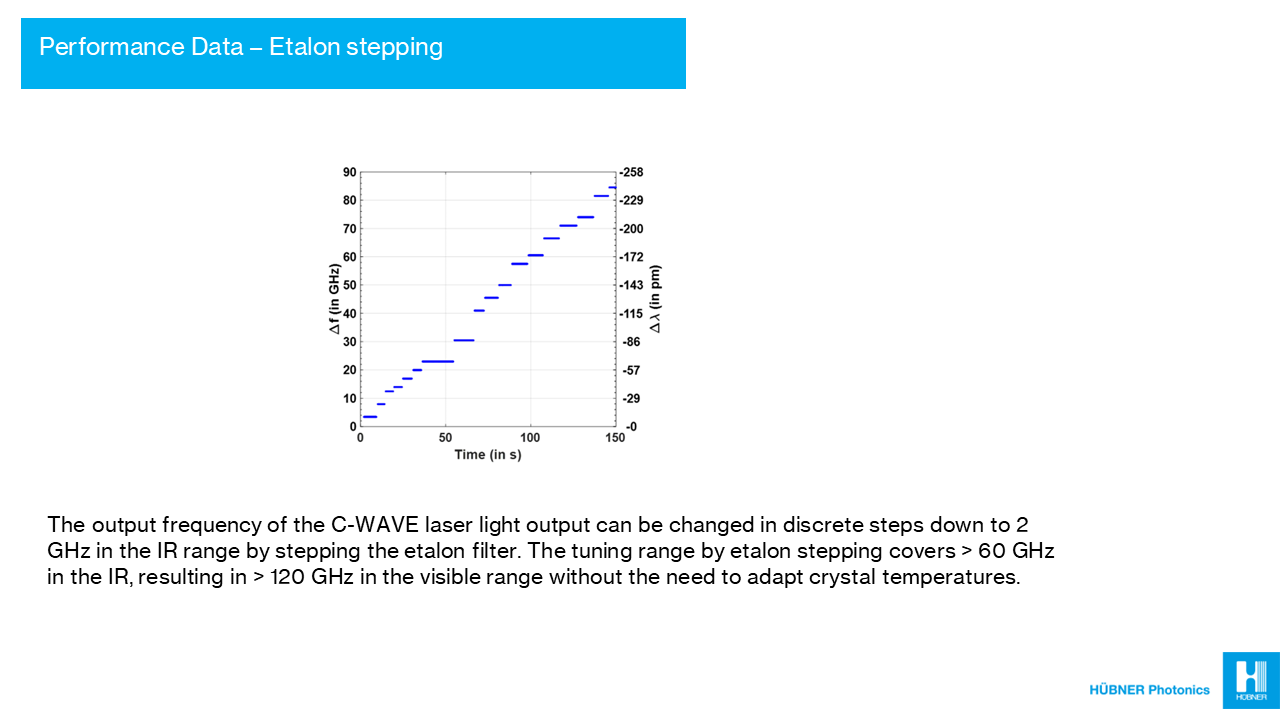
If your application requires fast tuning, either in discrete steps or truly continuous, this can be accomplished by the different tuning mechanisms provided.

Are fiber coupling options available for C-WAVE tunable lasers?2025-12-03T16:19:02+01:00

Standard fiber-coupling into broadband single-mode polarization-maintaining fibers is readily available for all visible wavelength tuning ranges covered by C-WAVE tunable lasers.

Please contact us for fiber-coupling options for the infrared wavelength tuning ranges or to discuss custom-tailored fiber-coupling options.

What is the expected lifetime of a C-WAVE tunable laser?2025-12-03T16:23:05+01:00

All optical components and coatings inside C-WAVE tunable lasers are operated at intensities far below their damage threshold, to ensure operation without any degradation over years of typical lab operation.

The typical lifetime of the pump lasers is >10.000 hrs.

Please contact us for any further questions on expected lifetime or long-term service contracts.

What are the lab requirements to reliably operate a C-WAVE tunable laser?2025-12-03T16:25:59+01:00

To ensure reliable operation within specifications, C-WAVE is to be installed on a vibration-isolated optical table and operated at ambient temperature in the range 20-25 C, with a stability better than +/- 2°C at relative humidity in the range 10-85% with a stability better than +/- 10%, and under clean air conditions (free of dust, laminar air flow box recommended).

Is a chiller required for C-WAVE tunable laser?2025-12-03T16:28:02+01:00

This depends on the C-WAVE model we look at.

C-WAVE NIR, C-WAVE GTR, C-WAVE VIS HP, and C-WAVE IR HP are passively cooled and require no water cooling.

C-WAVE BTS, C-WAVE VIS LP and C-WAVE IR HP require water cooling for the pump laser unit and (in case of C-WAV BTS) the Titanium-Sapphire crystal. For these models, a water chiller is included in the delivery.

If you are unsure of which Product, Series, Power or Wavelength you need, use our Product Selector.

Do you have a question?
Our laser experts are here to help you!

Go to Top