

Cobolt 06 in Non-Invasive Glucose Monitoring Study
A team of researchers from National Cheng Kung University in Taiwan has demonstrated a highly accurate method for measuring blood glucose levels without drawing blood, combining advanced optical sensing with machine learning. The study was published in IEEE Photonics Journal.
Current glucose monitoring typically relies on finger-prick blood samples, which can be painful and inconvenient for people living with diabetes. The new approach aims to provide a comfortable, non-invasive alternative while maintaining clinical-grade performance.
Using a technique called Mueller Matrix Polarimetry, the researchers shone a 660 nm laser onto human fingertips and analyzed how the tissue altered the light’s polarization. By extracting optical signatures linked to glucose and processing them with the XGBoost machine learning algorithm, the team was able to predict blood glucose concentrations with remarkable accuracy. For the experimental setup of the Mueller matrix polarimetry system the laser light source used included the Cobolt 06-MLD.
The study also highlighted the importance of accounting for biological interference from proteins such as albumin, which can influence optical measurements. Advanced feature selection techniques helped the machine-learning model distinguish glucose-related signals from these confounding effects.
By integrating polarimetric sensing with artificial intelligence could pave the way for future wearable or handheld glucose-monitoring devices.
While additional clinical validation is still needed, the work represents a significant step toward painless, real-time glucose monitoring for millions of people with diabetes
 Go back to all publications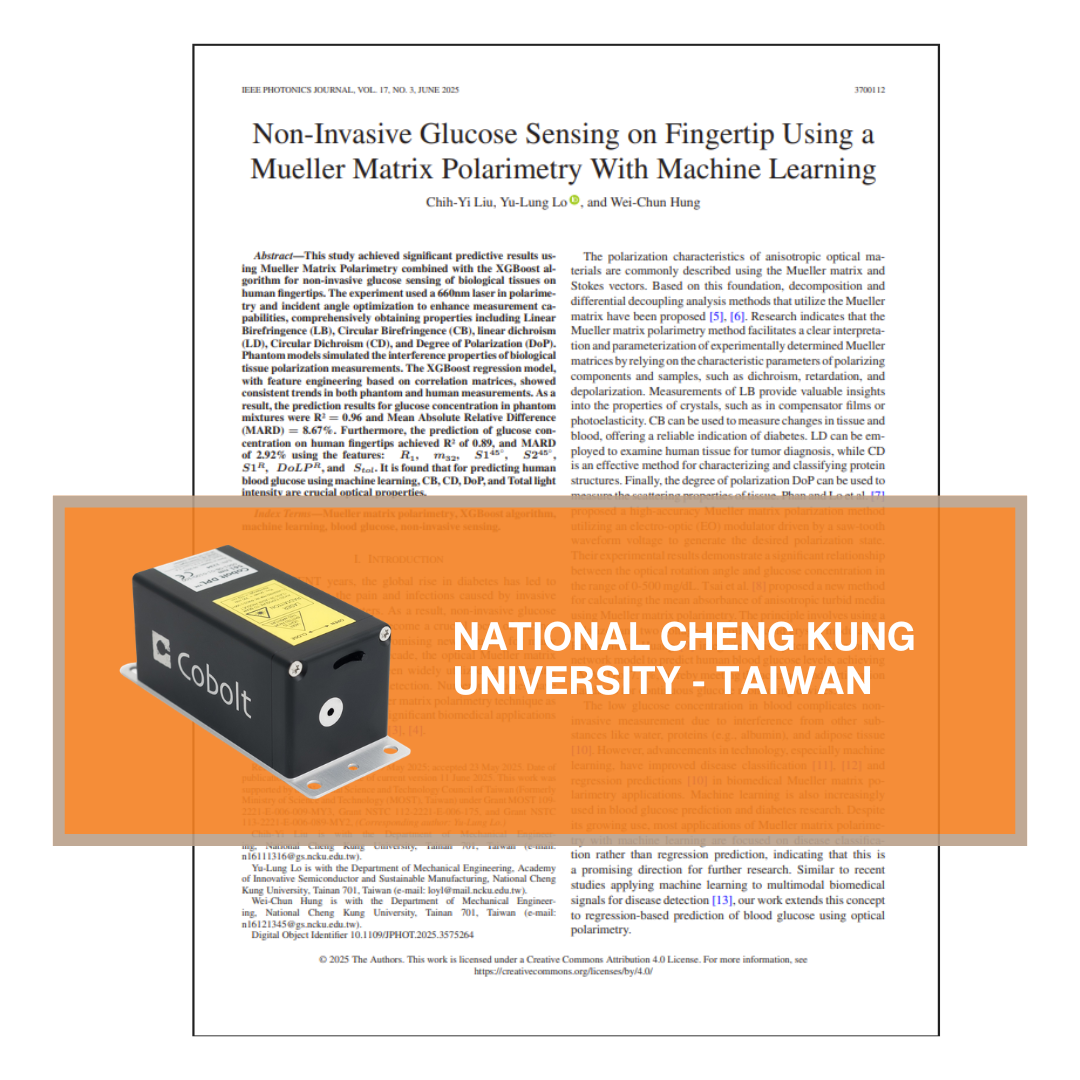
More resources
Looking for more in-depth information? Visit our Knowledge Bank page for detailed articles and insights on our products and technologies.